EMI License in Spain: Electronic Money Institution Authorization

We structure and defend your electronic money institution project before the Bank of Spain to secure your EMI license in Spain: regulatory fit analysis, programme of operations, complete application file, safeguarding of funds, AML/CFT, corporate governance and ongoing compliance.

Free consultation

We reply in under 24h

A different application for every fintech project

Wallets, prepaid platforms, fintechs issuing electronic money or operators seeking their own license: each project has its own regulatory fit and its own specific requirements.

Authorization

Regulatory fit as an electronic money institution

"Before opening the application file, you need to confirm whether your model really qualifies as an EMI and what kind of e-money issuance you carry out. That decision shapes everything else."

Bank of Spain

A solid, consistent application

"An EMI license is not won with nice-looking documents: you need consistency between business, governance, policies, technology, third parties and evidence of issuance and redemption."

Operations

Issuance, redemption and safeguarding

"The operating structure must hold up in practice: funds, issuance flow, redemption, reconciliations, incidents, customer service and controls that stand up to review."

Compliance

AML/CFT and ongoing control

"Authorization is not the end. An EMI needs working AML/KYC, internal control, reporting, training and constant monitoring from the first day of issuance."

Why is the EMI license critical for your project?

Operating without a license, filing an inconsistent application or improvising ongoing compliance can block the operations, investment and banking relationships of your e-money fintech.

The most common mistake: launching a wallet or prepaid solution without first establishing whether the activity requires an EMI license. The confusion surfaces once the product is already built, and the cost of fixing it skyrockets.

The Bank of Spain reviews consistency, not just documents: if business, policies, governance, AML/KYC and outsourcing do not fit together, the application loses strength and information requests multiply.

Safeguarding and internal control cannot be left until the end: they are central to making the EMI license defensible and to letting the institution scale its e-money issuance safely.

Very serious infringement Immediate cessation

Issuing electronic money or providing payment services without prior authorization can lead to the immediate shutdown of the business.

Financial penalties Substantial

Fines and personal liability for directors for issuing electronic money or providing financial services without a license.

Commercial risk Business on hold

Banks and financial partners require an active EMI license before integrating a fintech into their ecosystem: without one, agreements stall indefinitely.

Does your business model need an EMI license?

Before opening the application file, it pays to validate the regulatory perimeter, get the business in order and check whether your structure can meet the requirements for authorization, issuance, safeguarding, AML/CFT and ongoing control.

EMI license in Spain: common questions

What is an EMI license?

An EMI license is the authorization to operate as an electronic money institution. It allows you to issue electronic money (wallets, prepaid cards, stored balances) and to provide certain payment services within the regulatory framework applicable in Spain.

The key is not just obtaining the license, but being able to run an institution that can be supervised from day one: controlled issuance, guaranteed redemption, controls that are actually performed and compliance that works in real life.

When does a company need an EMI license?

When the business model involves issuing electronic money, holding user balances within its own structure, or offering a financial product that goes beyond being a mere technology provider.

The usual mistake is launching a wallet, payment account or prepaid solution without first establishing whether the activity falls under electronic money or another license type. That confusion tends to break the project when product, partners and investment are already committed.

What is the difference between an EMI, a payment institution and a bank?

Each license type has a different regulatory perimeter and its own requirements, depending on the service you want to provide:

  • A payment institution (PI) provides payment services without issuing electronic money: minimum capital from €20,000.
  • An electronic money institution (EMI) can also issue electronic money (wallets, prepaid cards, stored balances). Minimum capital of €350,000.
  • A bank can take deposits from the public, which greatly widens its perimeter and its capital and supervisory requirements.

Choosing the wrong license type at the outset delays the whole process and may force you to restructure your business model.

What does the Bank of Spain review in an EMI application?

It checks whether the application is consistent, complete and defensible: programme of operations, corporate structure, directors, key functions, internal policies, control system, issuance and redemption flow, third parties, technology and real capacity to operate.

The supervisor looks at whether the business described can be sustained by people, processes, contracts, controls and evidence that make sense together. Document consistency matters as much as the legal content.

Why are safeguarding and AML/CFT so important for an EMI?

Safeguarding of funds and the AML/CFT framework are two central pieces of an electronic money institution, not secondary annexes. They affect the quality of the application, the relationship with banking partners and the future strength of the institution.

They force you to pin down issuance, redemption, reconciliations, onboarding, monitoring, reporting, internal roles and evidence. When they are improvised, the supervisor notices quickly.

How long does it take to get an EMI license?

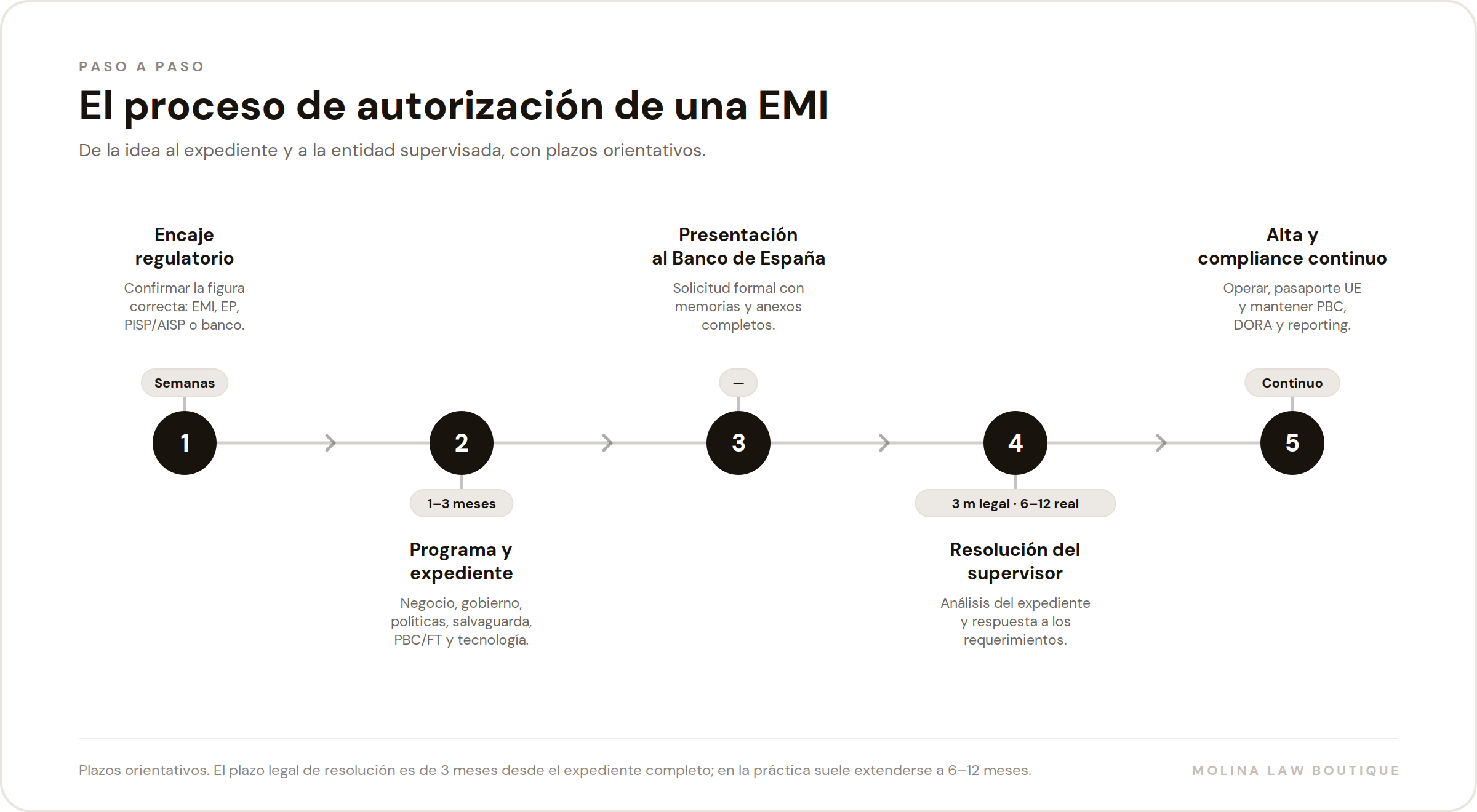
The statutory deadline for a decision is 3 months from submission of the complete application, although in practice the process can take 6-12 months depending on the complexity of the model and the quality of the application.

What makes an EMI license more expensive and slower is usually not drafting it but fixing it: redoing annexes, clarifying contradictions, answering information requests or redesigning parts of the business that had not been properly settled.

Can I operate while my EMI license application is pending?

As a general rule, no. Issuing electronic money without prior authorization is a very serious infringement.

Only a few limited exceptions exist, and they must be analyzed case by case (Spain has not implemented the optional exemption regime for very small e-money volumes that EU law allows). The usual alternative while your own license is being processed is to operate under the umbrella of an already authorized institution through an agent or regulated distribution agreement.

What happens after you obtain the EMI license?

The most important phase begins: operating as a supervised institution with ongoing compliance, internal control, incident follow-up, third-party oversight, training and reporting.

  • Maintaining AML/KYC controls and active monitoring.
  • DORA compliance: ICT risk management, business continuity, incident reporting.
  • Periodic reporting to the Bank of Spain and handling of information requests.
  • Review of critical third parties, SLAs and ongoing outsourcing.
  • Periodic audits and updates to keep pace with regulatory change.

The EMI license is not the end of the project: it is the starting point of supervised e-money operations.

EMI license: EU passport, IBANs, cards and key differences

Can an EMI operate across the European Union?

Yes. Once authorized by the Bank of Spain, an EMI can operate in the 30 countries of the European Economic Area through the EU passport: a passporting notification is enough, with no need for a new local authorization in each country.

Can an EMI issue IBANs and cards?

Yes. An electronic money institution can offer accounts with their own IBAN, digital wallets, physical and virtual prepaid cards and domestic and international transfers, always within the scope of its authorized services.

What is the difference between an EMI and a neobank?

A neobank usually operates with its own banking license or relies on an EMI or a payment institution. The key difference is that an EMI does not take deposits from the public or grant credit with its clients' funds: those funds must be safeguarded. A bank, by contrast, can take deposits and lend.

What is an EMI's European passport?

It is the mechanism that allows an EMI authorized in Spain to provide services in the rest of the EEA (under the freedom to provide services or through a branch) by notifying the supervisor, without applying for a new authorization in each Member State. It is one of the main attractions of this license.

Is there a "small EMI" or exemption regime in Spain?

The E-Money Directive (EMD2) lets Member States create an optional regime for small issuers (average outstanding electronic money of up to €5 million) operating domestically, with lighter requirements but no EU passport. Spain has not implemented this regime, so there is no "small EMI" license in Spain: issuing electronic money requires a full EMI authorization from the Bank of Spain.

How do MiCA and PSD3 affect an EMI?

MiCA is already in force: its rules on e-money tokens (EMTs) have applied since June 2024 and affect EMIs that issue them, with additional reserve and governance requirements. In Spain, EMTs are supervised by the Bank of Spain (the CNMV supervises other crypto-assets and CASPs). On PSD3 and the new Payment Services Regulation (PSR), the European Parliament and the Council reached an agreement at the end of 2025; the new rules are set to merge payment institutions and electronic money institutions into a single category, with application expected around 2027-2028. It makes sense to design your project with this horizon in mind.

How much does an EMI license cost? Pricing and comparison of license types

There is no single fee: the cost depends on the regulatory capital required and the complexity of the application. We help you size it before you start.

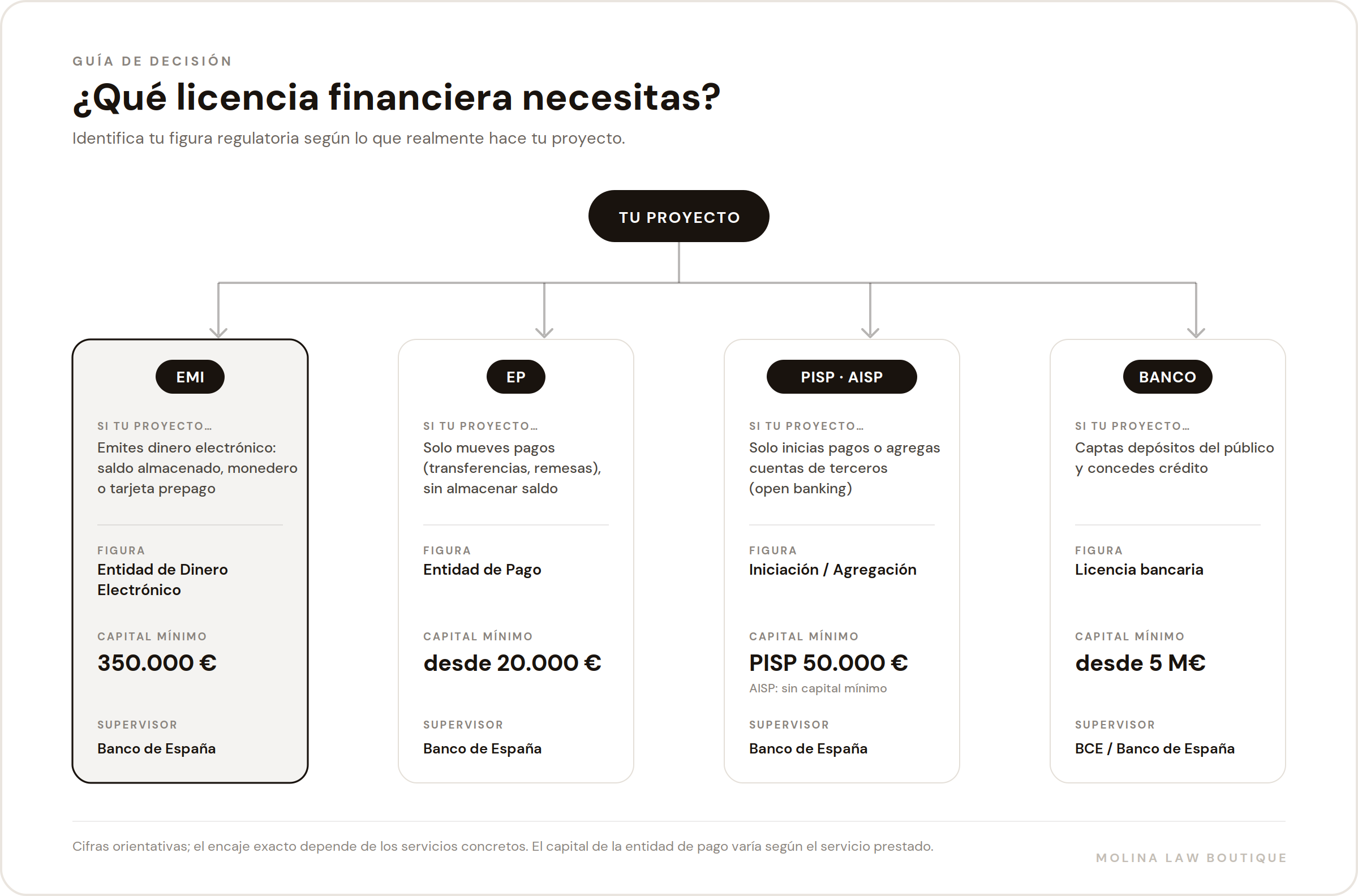
Decision tree: which financial license you need (EMI, PI, PISP/AISP or bank), with minimum capital and supervisor

What drives the cost of an EMI license

The total cost of launching an electronic money institution combines two elements: the regulatory capital required by law and the cost of structuring the project and the application.

Minimum capital
€350,000 of initial capital, plus own funds proportionate to the electronic money in circulation.
Complexity
Number of services, expected volume, use of agents or distributors, and EU passporting.
Starting point
Structuring from scratch is not the same as reviewing an application that is already under way.
Recurring cost
Ongoing compliance, AML/CFT, DORA, audits and reporting once the institution is authorized.

How we build your budget

Before committing to fees, we settle the regulatory fit and the real scope of the project. That way you avoid paying for work you don't need and get a realistic estimate of effort and timelines.

  1. Initial diagnosis of the model and the right license type.
  2. Phased proposal: regulatory fit, application, safeguarding/AML and compliance.
  3. A timeline estimate tailored to your case, not generic templates.

Request an estimate for your EMI project →

Comparison of EMI, payment institution, bank and PISP/AISP
License type EMI · electronic money Payment institution (PI) Bank PISP / AISP
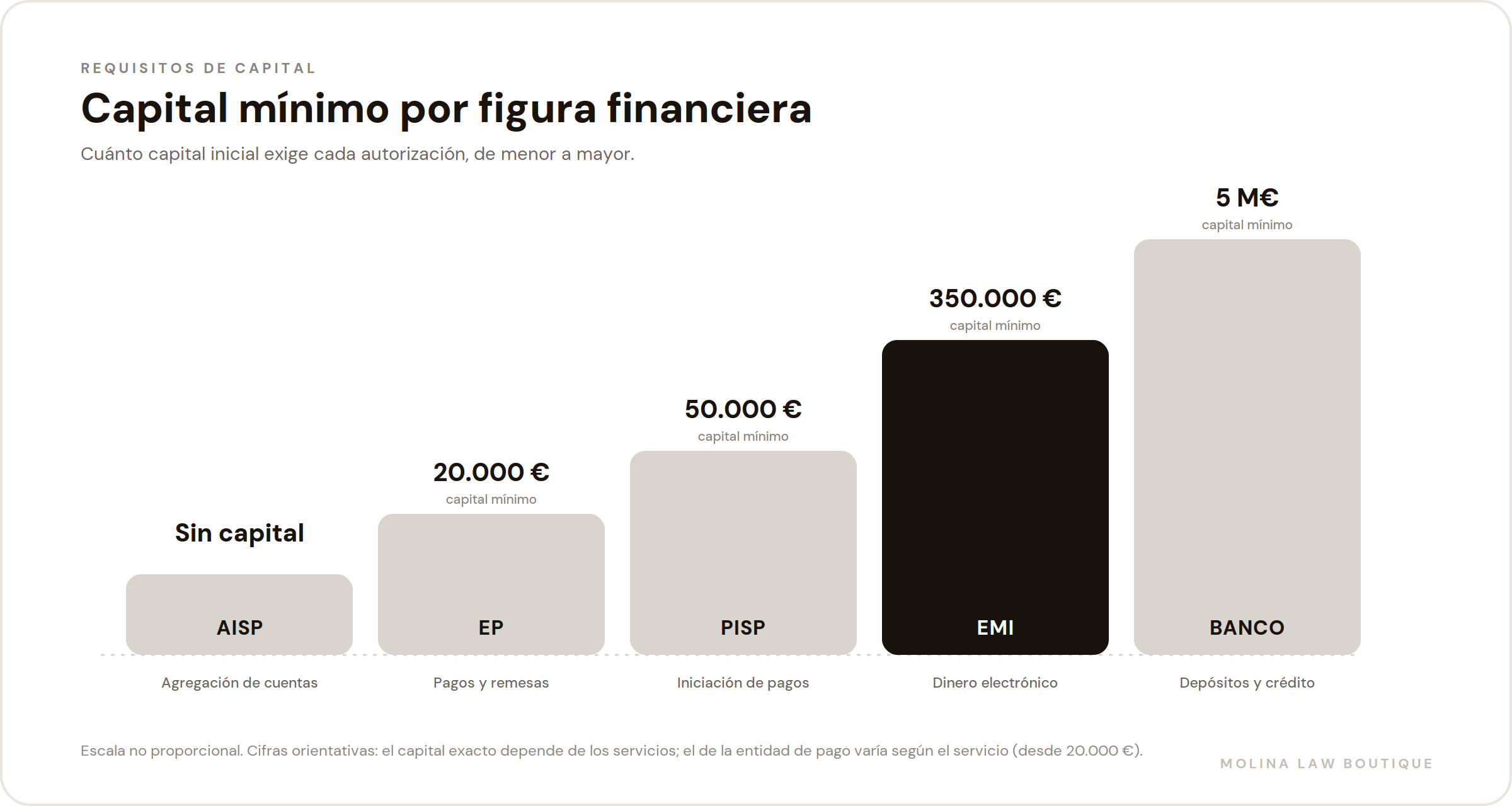
Minimum capital €350,000 From €20,000 €18M minimum in Spain AISP: no capital · PISP: €50,000
Issues electronic money Yes No Yes (and more) No
Takes deposits from the public No No Yes No
Holds client funds Yes, with safeguarding Yes, with safeguarding Yes No
Supervisor Bank of Spain Bank of Spain ECB / Bank of Spain Bank of Spain
Typical use case Wallets, prepaid, stored balances Transfers, payments, remittances Deposits, lending, banking Open banking: payment initiation or account aggregation

Indicative figures for comparison purposes. The exact capital and regulatory fit depend on the specific services the institution will provide; they should be validated case by case before starting the application.

Minimum capital by type of financial institution: AISP, payment institution, PISP, EMI and bank

How to set up an electronic money institution: a practical guide

An EMI license is not just a formality: it is a system that must show consistency between business model, issuance, operations, controls and evidence. The key is to build, from the outset, an institution that can withstand real supervision.

Application

What the supervisor really looks at

The Bank of Spain does not just review the business idea. It analyzes whether the structure can support it: fit and proper directors, key functions, consistent policies, workable controls and evidence of real operational capacity to issue electronic money.

Safeguarding

The piece most often improvised

The issuance and redemption flow, reconciliations, account segregation and incident management must be designed before the application, not as an appendix. A failure here blocks EMI authorization.

Ongoing compliance

The license is the beginning, not the end

Working AML/KYC, DORA, reporting, audits and the handling of supervisory information requests must be designed to last over time, not just to get the initial EMI application through.

EMI checklist: preparation in 10 steps

  1. Regulatory fit: confirm whether the model requires an EMI license and which specific e-money services will be provided.
  2. Right license type: assess whether an EMI is the correct choice compared with a PI, PISP/AISP or other financial authorizations.
  3. Corporate structure: company, minimum capital (€350,000), shareholders, directors and demonstrable fitness and propriety.
  4. Programme of operations: a consistent description of the business, clients, channels, technology, issuance and partners.
  5. Governance and key functions: organization chart, segregation of duties, heads of compliance, audit and risk.
  6. Safeguarding of funds: define the issuance and redemption flow, accounts, reconciliations, incident management and traceability.
  7. AML/CFT framework: risk assessment, KYC/onboarding, monitoring, escalation and training.
  8. Outsourcing and critical third parties: contracts, SLAs, security, continuity and documented subcontracting.
  9. DORA: ICT risk management, continuity policy, incident register and critical providers.
  10. Ongoing compliance: design post-authorization reporting, audits and the handling of information requests from the start.

If you want to structure your EMI application from scratch or review the current status of your project, see our fintech regulation services or our dedicated fintech compliance practice.

The EMI license in operational mode

EMI authorization in Spain: from idea to Bank of Spain application

An effective EMI license is not a dossier: it is a set of consistent decisions (regulatory fit, issuance and redemption, AML/KYC, governance and outsourcing) backed by traceability. Here is a visual panel to show how it works in practice.

Step-by-step EMI license authorization process: regulatory fit, application, filing with the Bank of Spain, decision and ongoing compliance
Regulatory fit for an electronic money institution (EMI)1) Fit

Regulatory fit: define first, then apply

The goal is not to "get the EMI license faster": it is to make sure the model needs one, of what type and with what issuance perimeter. That decision shapes the whole application.

  • Analysis of the actual service (wallets, prepaid, balances)
  • EMI vs PI vs PISP/AISP comparison
  • E-money issuance perimeter
Bank of Spain EMI license application file2) Application

Application: consistency across every piece

The supervisor reviews consistency. Programme of operations, policies, governance, technology and outsourcing must fit together, with no internal contradictions in the e-money model.

  • Detailed programme of operations
  • Internal policies and risk map
  • Fitness and propriety of directors
Safeguarding of funds in EMI e-money issuance3) Safeguarding

Safeguarding: the most improvised piece

Issuance and redemption flow, segregated accounts, reconciliations and incidents. When it is designed late, it blocks authorization or creates structural gaps once the EMI license has been granted.

  • Issuance, redemption and segregation flow
  • Reconciliations and incidents
  • Traceability of e-money flows
EMI license decision map: choosing the right regulatory licenseQuick decision

Practical map: which license does your project need?

Wallets / prepaid

EMI license: you issue electronic money (stored balance, prepaid card). Minimum capital €350,000.

Payments only

PI license: transfers, direct debits, card payments or remittances without issuing electronic money.

Open banking

PISP/AISP registration: you initiate payments or aggregate bank accounts without handling client funds.

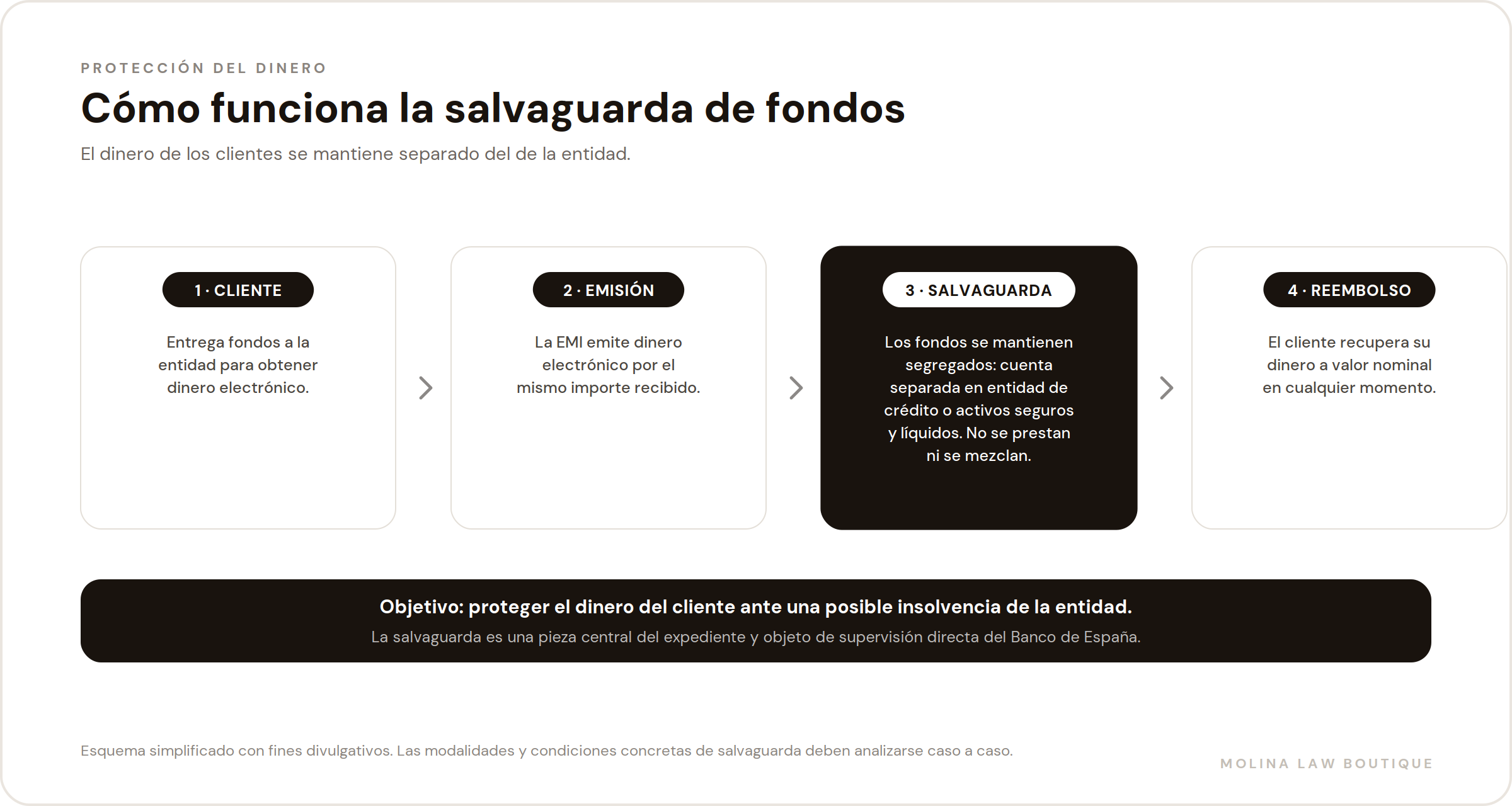
How EMI safeguarding of funds works: e-money issuance, segregated accounts and right of redemption
See our fintech regulation services Payment institution license
EMI playbook

The EMI license in practice

Application block
What is expected
Typical evidence

Regulatory fit

A reasoned analysis showing that the actual activity requires an EMI license and not another license type (PI, PISP, unregulated activity).

Regulatory fit report, description of the actual service and comparison of e-money license types.

Programme of operations

A consistent description of the business, issuance, clients, channels, technology and partners that supports the supervisor's review.

Detailed business report, projections, third-party contracts and the EMI's functional organization chart.

Safeguarding of funds

A clear issuance and redemption flow for electronic money, account segregation, reconciliations and properly managed incidents.

Safeguarding policy, description of the flow, banking agreements and reconciliation procedures.

AML/KYC (AML/CFT)

Risk assessment, onboarding, monitoring and reporting proportionate to the EMI's risk profile.

AML/CFT manual, KYC files, alert log and evidence of staff training.

Governance and control

Fit and proper directors, key functions, segregation of responsibilities and an internal control system for the EMI.

Board minutes, appointments, conflicts of interest policy, risk map and annual audit plan.

Common mistakes that delay or block an EMI license

Spot them before filing your application to avoid costly information requests.

  • Starting on the application before settling the regulatory fit between EMI, PI and other license types.
  • Treating legal, product, technology and operations as if they were separate worlds.
  • Designing safeguarding and AML/CFT as appendices to the application instead of central pieces.
  • Directors who cannot demonstrate fitness, propriety and independence to the supervisor.
  • Outsourcing without contracts, SLAs or a documented continuity framework.
Working glossary

Key concepts: the electronic money institution license

If you are structuring an EMI license, these terms come up in the application, in your internal policies and in your dealings with the supervisor. Understanding them well helps you build a consistent project.

EMIBasics

Electronic Money Institution

An institution authorized to issue electronic money (wallets, prepaid cards, stored balances) and to provide related payment services. Minimum capital of €350,000.

Governed by: EMD2 / Law 21/2011 / Royal Decree-law 19/2018.
Electronic moneyEMI core

E-money: stored value

Monetary value stored electronically, issued on receipt of funds, accepted as a means of payment by persons other than the issuer and redeemable at any time at par value.

Not to be confused with crypto-assets or bank deposits.
SafeguardingClient funds

Safeguarding of funds

The obligation to keep the funds received in exchange for electronic money segregated and protected against the institution's possible insolvency. A central piece of the EMI application.

Evidence: segregated accounts + safeguarding policy.
RedemptionEMI obligation

Right of redemption

The right of the e-money holder to request, at any time, redemption at par value of the funds in circulation. It must be guaranteed both contractually and operationally.

Key: a clear procedure, set timelines and no abusive fees.
PISP / AISPOpen banking

Payment initiation / Account information

PSD2 license types for open banking: the PISP initiates payments from third-party accounts and the AISP aggregates banking information, without handling client funds or issuing electronic money.

They require specific registration with the Bank of Spain.
DORAICT resilience

Digital Operational Resilience Act

EU regulation applicable since January 2025 that requires an ICT risk management framework, business continuity, incident reporting and oversight of critical providers.

Applies to all PIs, EMIs and investment firms authorized in the EU.
Programme of operationsApplication

Regulatory business plan

The core document of the application: it describes the services to be provided, the issuance model, the operating structure, the clients and the partners of the future electronic money institution.

It must be consistent with every policy in the EMI application.
Key functionsGovernance

Key Function Holders

The heads of compliance, internal audit, risk and AML, who must be identified, be fit and proper and have real capacity to perform their role in the EMI.

Evidence: appointments, CVs, independence policies.
Critical outsourcingThird parties

Outsourcing of essential functions

Technology or essential service providers must be documented: contracts, SLAs, security, continuity and an exit plan for contingencies.

The Bank of Spain requires traceability of the EMI's critical outsourcing.

Guide: EMI license in Spain, your passport to the European market

Download our guide covering the full process: entry requirements, the path to authorization, the pillars of the application, the full EMI compared with the EU "small EMI" regime, and the impact of MiCA and PSD3.

  • Capital, local substance and governance requirements
  • Realistic timelines and stages of the process before the Bank of Spain
  • Full EMI vs "small EMI" under EU law: the key differences
  • Regulatory horizon: the end of the MiCA transitional period (July 2026) and the arrival of PSD3/PSR
Download the guide (PDF)

Book a call

Tell us about your project and we will explain how to structure your EMI license in an operational way and with the shortest possible processing time.

Regulatory framework for electronic money institutions in Spain: EMD2 and Law 21/2011

Electronic money institutions in Spain are mainly governed by Law 21/2011 of 26 July on electronic money, which transposes Directive 2009/110/EC (EMD2), and, on a supplementary basis, by Royal Decree-law 19/2018 on payment services. Authorization and supervision fall to the Bank of Spain, which assesses the suitability of the project, the governance structure, the robustness of the application and the real operational capacity of the future institution.

Minimum capital and own funds

The minimum capital required for an EMI license is €350,000, significantly higher than for a payment institution. In addition, the institution must maintain sufficient own funds based on the volume of electronic money in circulation. This higher requirement reflects the greater risk of issuing electronic money compared with merely intermediating payments.

Issuance, redemption and safeguarding of funds

One of the most critical obligations of an EMI is to guarantee e-money holders' right of redemption at par value and at any time. Funds received in exchange for issuing electronic money must be held in segregated accounts at credit institutions or invested in secure, liquid assets. Compliance with this safeguarding obligation is subject to direct supervision.

Small EMI exemption regime: not available in Spain

The E-Money Directive (EMD2) allows Member States to provide an exemption regime for institutions whose average outstanding electronic money does not exceed €5 million, with lighter capital and documentation requirements but a narrower operating scope and no EU passport. Spain has not implemented this regime, so it is not an alternative to the full license: issuing electronic money in Spain requires a full EMI authorization from the Bank of Spain.

DORA and digital operational resilience

Since January 2025, the DORA Regulation has applied to all electronic money institutions authorized in the EU. It requires an ICT risk management framework, a business continuity policy, incident logging and reporting, digital operational resilience testing and oversight of critical technology providers.

EMD2 Law 21/2011 Bank of Spain DORA AML/KYC Safeguarding PSD2